
L7|ESP® for the Diagnostics Industry
streamlining workflows + improving accuracy
For Diagnostics companies involved in assay development and commercialization of molecular diagnostics and companion diagnostics, L7|ESP provides a complete platform for the design and execution of complex assays from sample ingest to clinical report generation. L7|ESP supports integration to instruments and lab automation equipment.
molecular diagnostics
Molecular diagnostics is a rapidly evolving field that plays a crucial role in disease detection, monitoring, and personalized medicine. L7|ESP, with its powerful data management and analytics capabilities, offers valuable support to molecular diagnostics companies. Whether it’s genetic testing, infectious disease screening, or precision medicine, L7|ESP enables streamlined data integration, analysis, and interpretation.
With L7|ESP, molecular diagnostics companies can efficiently manage and analyze diverse data types, including genomics, proteomics, and clinical data. The platform’s centralized data management system allows for seamless integration of data from multiple sources, facilitating comprehensive analysis and interpretation. This empowers researchers and healthcare professionals to make informed decisions based on accurate and reliable molecular diagnostic insights.
Additionally, L7|ESP’s advanced analytics tools and machine learning capabilities enable the identification of patterns, biomarkers, and predictive models. This helps improve the accuracy and efficiency of molecular diagnostics, leading to earlier disease detection, more precise treatment selection, and better patient outcomes. L7|ESP’s customizable workflows and automated pipelines also streamline the diagnostic process, allowing for increased throughput and reduced turnaround time.

supporting case study

Connect with the L7 Team to find out more about the work we did with Quest Diagnostics.
companion diagnostics
Companion diagnostics are transforming the way healthcare professionals approach treatment decisions by tailoring therapies to individual patients. L7|ESP offers robust capabilities to support companion diagnostics development and implementation. By integrating clinical, genomic, and patient data, L7|ESP enables the identification of specific biomarkers and their association with therapeutic responses.
L7|ESP’s unified platform provides a comprehensive solution for managing and analyzing the complex data involved in companion diagnostics. By combining clinical data with genomic information, researchers and clinicians can gain insights into patient populations, identify subgroups that may respond differently to treatments, and develop targeted companion diagnostic tests.
Moreover, L7|ESP’s machine learning algorithms can be leveraged to develop predictive models that assist in patient stratification and treatment decision-making. This empowers healthcare professionals to select the most appropriate therapies for patients, maximizing the chances of successful treatment outcomes while minimizing potential adverse effects.
L7|ESP’s unified platform is a powerful tool for molecular diagnostics and companion diagnostics companies. Its data management, analytics, and machine learning capabilities enable efficient integration and analysis of diverse data types, driving advancements in disease detection, personalized medicine, and companion diagnostic development. With L7|ESP, molecular diagnostics and companion diagnostics companies can accelerate their research, improve patient care, and contribute to advancements in the field of diagnostics.

supporting case study

Connect with the L7 Team to find out more about the work we did with QIAGEN.
resources
Dive deeper into the capabilities that power the L7|ESP platform and discover what’s possible with data orchestration built for life sciences.
L7|ESP
brochure

L7|HUB
datasheet

L7|INTELLIGENCE
datasheet

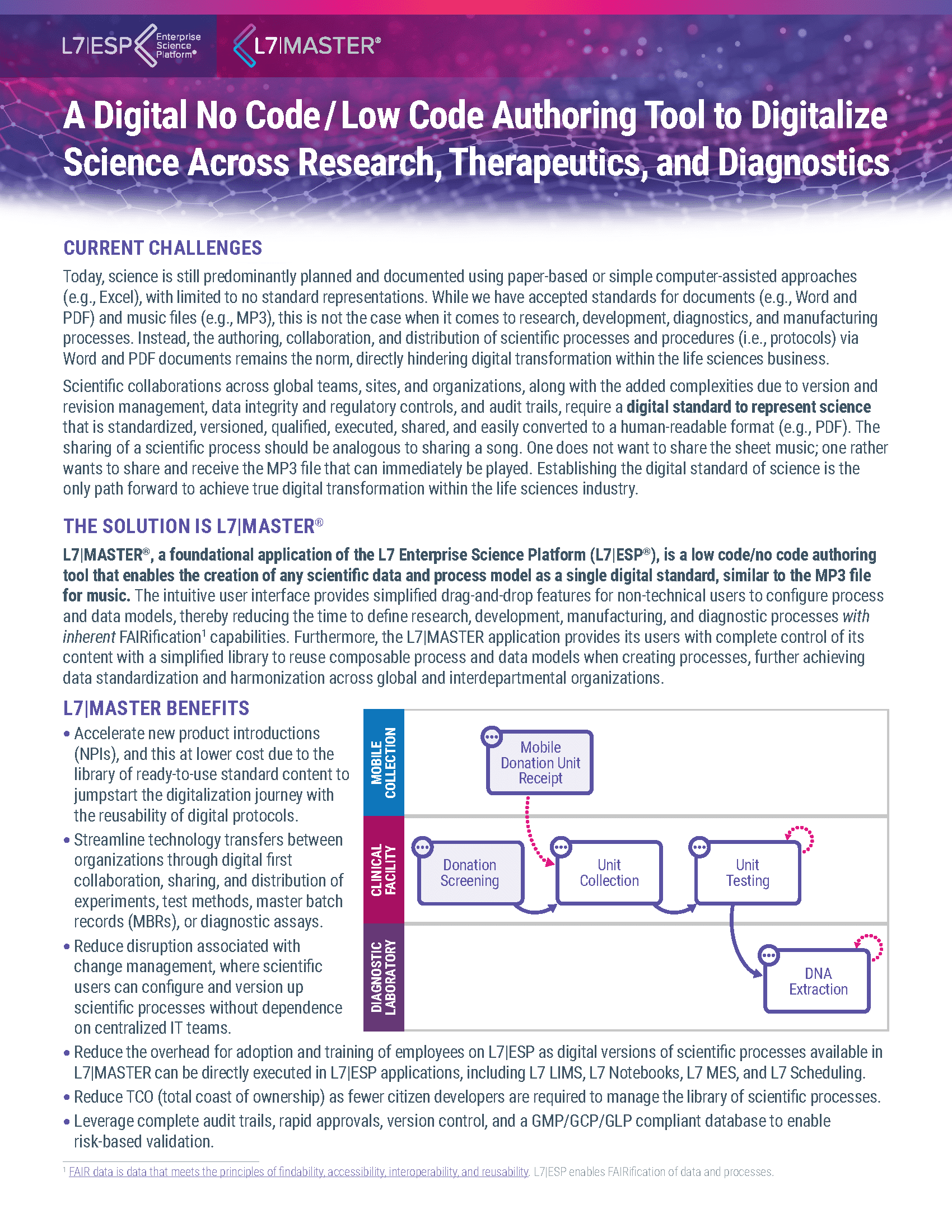
L7|MASTER
datasheet
L7 Notebooks app
datasheet

L7 LIMS app
datasheet

L7 MES app
datasheet

L7 scheduling app
datasheet
